

-
Research Paper
-
Relative importance of evaluation criteria for utility tunnel performance improvement candidate projects using the analytic hierarchy process
AHP 기반 공동구 성능개선 검토대상 평가 항목의 상대적 중요도 산정
-
Yongjun Lee, Young-Jong Sim
이용준, 심영종
- Utility tunnels accommodate critical urban lifelines, including electricity, telecommunications, water supply, and district heating pipelines. The Korean performance improvement standards require evaluation …
공동구는 전력, 통신, 상수도 및 열수송관 등 도시기능의 핵심 라이프라인을 공동 수용하는 기반 시설로서, 사고 발생 시 서비스 중단의 파급효과가 크고 구조물의 …
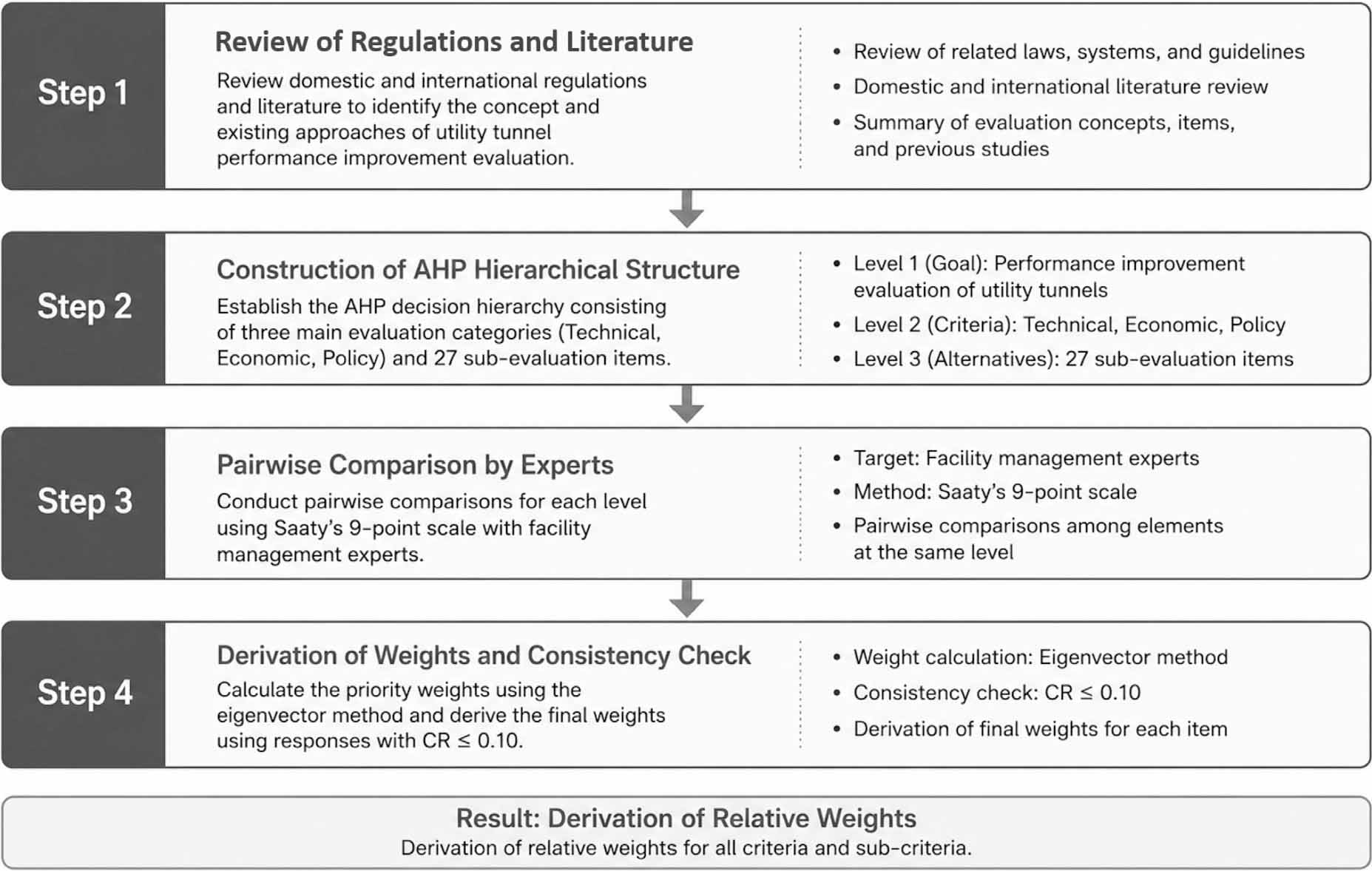
- Utility tunnels accommodate critical urban lifelines, including electricity, telecommunications, water supply, and district heating pipelines. The Korean performance improvement standards require evaluation results for technical feasibility, economic feasibility, and policy considerations to be quantified using weighted scores, but specific weights for the 27 detailed evaluation criteria are not provided. This study applied the analytic hierarchy process (AHP) to derive the relative weights of the evaluation criteria based on expert pairwise comparisons. The upper-level weights were 0.49 for technical feasibility, 0.38 for economic feasibility, and 0.13 for policy considerations. Deterioration and inspection results, adequacy of capacity and size, and current demand were identified as the most important criteria. The proposed weights provide a practical basis for supporting consistent decision-making and prioritizing utility tunnel performance improvement projects.
- COLLAPSE
공동구는 전력, 통신, 상수도 및 열수송관 등 도시기능의 핵심 라이프라인을 공동 수용하는 기반 시설로서, 사고 발생 시 서비스 중단의 파급효과가 크고 구조물의 유지보수도 어렵다. 국내 공동구 성능개선 기준은 기술성, 경제성 및 정책성의 3개 평가 항목에 대한 평가결과를 사업 특성에 따른 가중치 부여 방식으로 정량화하도록 규정하고 있으나, 각 평가 항목별 27개 세부 평가 항목에 적용할 구체적인 가중치는 제시하지 않고 있다. 이에 본 연구는 현행 기준의 평가 항목을 계층화하고, 시설물 유지관리 전문가의 쌍대비교 결과를 이용하여 계층분석법(AHP) 가중치를 산정하였다. 상위기준의 가중치는 기술성 0.49, 경제성 0.38, 정책성 0.13으로 분석되었다. 기술성에서는 노후도 및 점검·진단 결과가 0.54, 경제성의 중간계층에서는 편익이 0.38, 정책성에서는 안전성 평가가 0.26으로 가장 높았다. 계층별 가중치를 종합한 전체 중요도에서는 노후도 및 점검·진단 결과, 용량·규모 적정성, 사용수요가 우선순위 상위 항목으로 나타났다. 이 결과는 관리주체가 현행 기준에 따라 성능개선 검토대상을 일관되게 평가하고 제한된 예산의 우선순위를 설명하는 기초자료로 활용될 수 있다.
-
Relative importance of evaluation criteria for utility tunnel performance improvement candidate projects using the analytic hierarchy process
-
Research Paper
-
Evaluation of motion-blur directionality at different speeds in a high-speed machine vision scanning system
고속 머신비전 터널 스캐닝 시스템의 주행 속도별 모션 블러 방향성 평가
-
Chulhee Lee, Dongku Kim, Donggyou Kim, Jun-Beom An
이철희, 김동구, 김동규, 안준범
- Motion-blur directionality under the travel-speed conditions of tunnel scanning systems operating in actual tunnels remains insufficiently quantified. This study measured horizontal and …
실제 터널 내에서 운용되는 터널 스캐닝 시스템의 이동 속도 조건에서 모션 블러 방향성은 충분히 정량화되지 않았다. 본 연구에서는 고속 머신비전 터널 스캐닝 …
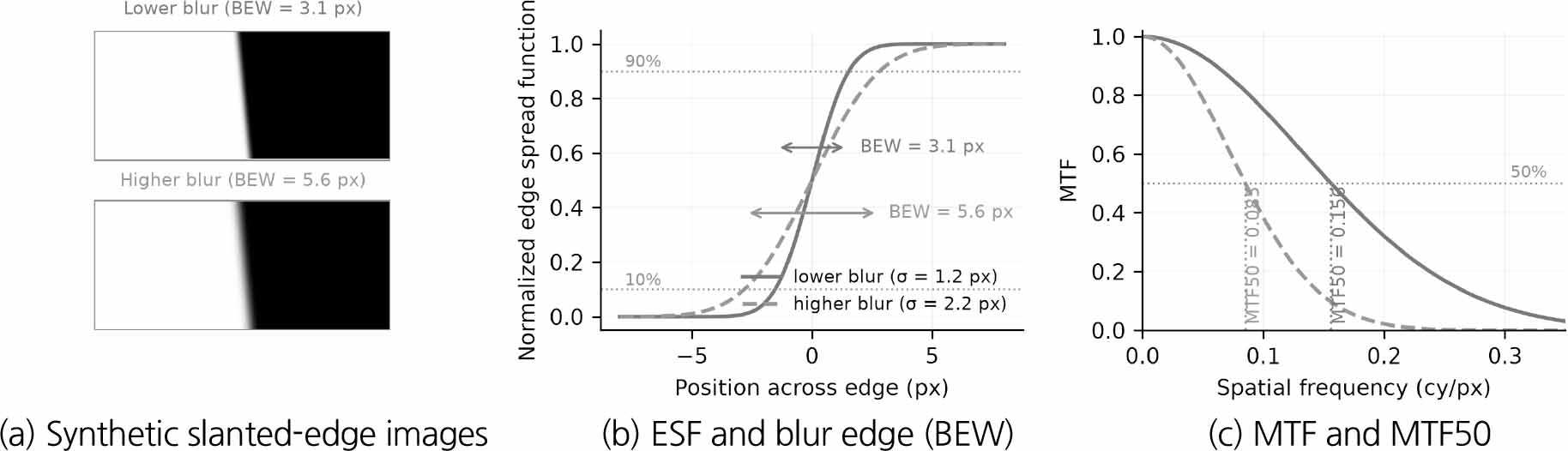
- Motion-blur directionality under the travel-speed conditions of tunnel scanning systems operating in actual tunnels remains insufficiently quantified. This study measured horizontal and vertical optical performance using the lower camera of a high-speed machine-vision tunnel scanning system under 50 conditions combining vehicle speed (60 and 80 km/h), ISO sensitivity (100–1600), and imaging distance (2.5–6.5 m). The spatial frequency at 50% modulation transfer (MTF50) and blur edge width (BEW) were evaluated. Across 25 experimental conditions available for speed-wise comparison, increasing speed reduced horizontal and vertical MTF50 by 8.98% and 1.65%, respectively, and increased BEW by 7.89% and 1.34%. The between-direction speed-change difference was -0.00767 cy/px for MTF50 and 0.330 px for BEW, indicating that degradation was concentrated in the vehicle-travel direction. ISO sensitivity had no significant main effect, whereas optical performance differed significantly across imaging-distance levels and associated zoom/focus settings. These findings support direction-aware optical-quality control in high-speed tunnel imaging but are limited to two speed levels, one camera, and a design without independent replication for each condition.
- COLLAPSE
실제 터널 내에서 운용되는 터널 스캐닝 시스템의 이동 속도 조건에서 모션 블러 방향성은 충분히 정량화되지 않았다. 본 연구에서는 고속 머신비전 터널 스캐닝 시스템의 하부 카메라를 대상으로 차량 속도(60 및 80 km/h), ISO 감도(100–1600) 및 촬영 거리(2.5–6.5 m)를 조합한 50개 조건에서 수평·수직 방향의 변조전달함수가 저주파 응답의 50%로 감소하는 공간주파수(MTF50)와 흐림 에지 폭(BEW)을 측정하였다. 속도별 비교가 가능한 25개 실험 조건에서 속도가 증가함에 따라 MTF50은 수평 및 수직 방향에서 각각 8.98%와 1.65% 감소하였고, BEW는 각각 7.89%와 1.34% 증가하였다. 수평·수직 방향 간 속도 변화량 차이는 MTF50에서 -0.00767 cy/px, BEW에서 0.330 px로 나타나 광학 성능 저하가 차량 진행 방향에 상대적으로 집중되었다. ISO 감도의 주효과는 유의하지 않았으나, 촬영 거리와 연계된 줌·초점 설정에 따른 차이는 유의하였다. 본 결과는 고속 터널 영상 취득에서 주행 방향을 고려한 광학 품질 관리의 필요성을 보여주며, 두 속도 수준, 단일 카메라 및 조건별 독립 반복이 없는 실험설계에 한정하여 해석해야 한다.
-
Evaluation of motion-blur directionality at different speeds in a high-speed machine vision scanning system
-
Research Paper
-
Estimation of passive earth pressure behind a reaction wall in undrained clay using upper and lower bound methods
상·하계법을 이용한 비배수 점토지반에서의 반력벽체 배면지반의 수동토압 산정
-
Jun-Hyeong Lee, Sunghwan Jo, Subin Kim, Yong-Joo Lee
이준형, 조성환, 김수빈, 이용주
- This study evaluated the passive earth pressure mobilized in the soil behind a reaction wall during trenchless pipe jacking in undrained clay …
이 논문은 비배수 점토지반에서 추진관의 비개착 공법 시 반력벽체 배면지반에 작용하는 수동토압을 상계법(UB)과 하계법(LB)을 이용하여 평가하는 방법을 제시하였다. 또한, 이를 PLAXIS 2D를 …
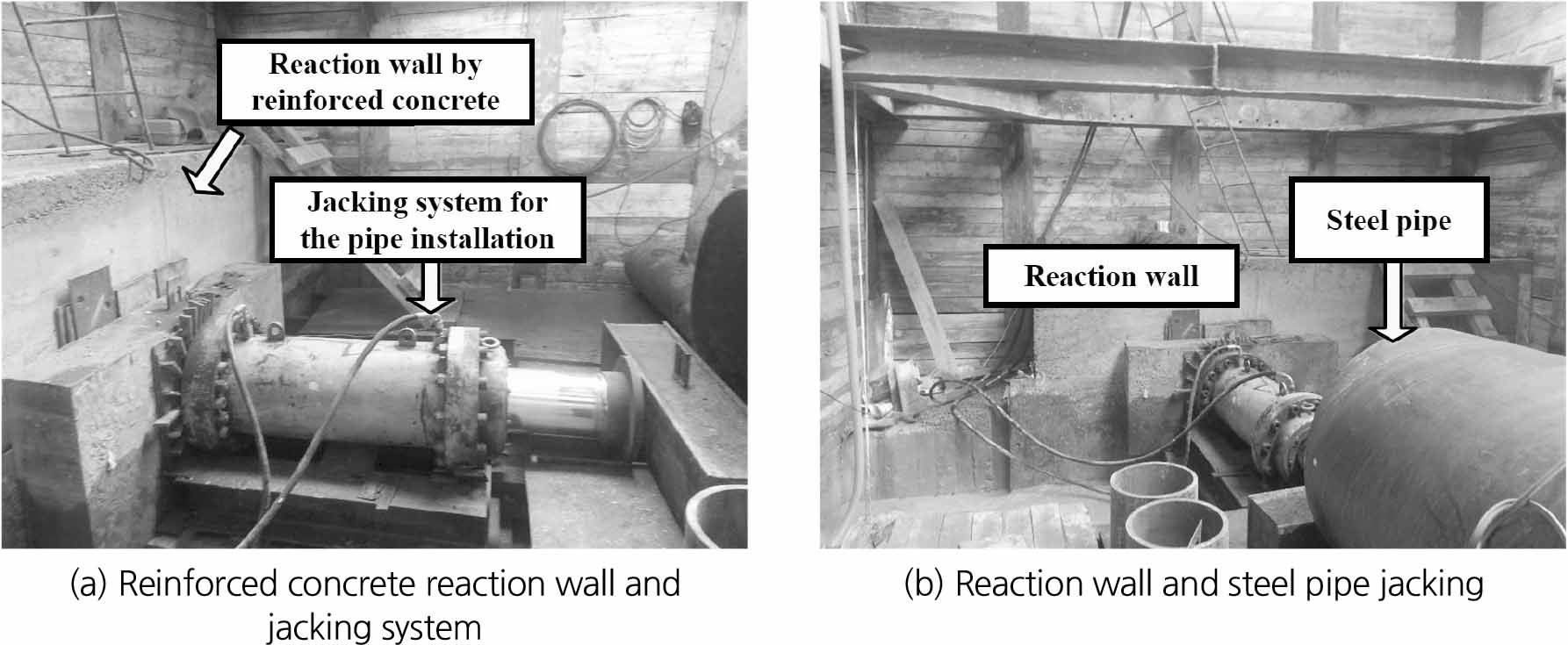
- This study evaluated the passive earth pressure mobilized in the soil behind a reaction wall during trenchless pipe jacking in undrained clay using the upper bound (UB) method, lower bound (LB) method, and PLAXIS 2D numerical analysis. The LB method estimated the lower limit by constructing a stress field satisfying stress equilibrium and yield conditions with the wall-soil interface shear condition, whereas the UB method estimated the upper limit using a failure mechanism and the principle of virtual work. In the numerical analysis, staged horizontal displacement was applied to the reaction wall, and the passive earth pressure rapidly increased at the initial displacement stage before converging to a nearly constant value. Although local differences were observed depending on the offset distance behind the reaction, the results at the main offset distances were located between the LB and UB solutions, indicating that the passive earth pressure behind a reaction wall can be reasonably evaluated within the theoretical range rather than as a single deterministic value in practical design.
- COLLAPSE
이 논문은 비배수 점토지반에서 추진관의 비개착 공법 시 반력벽체 배면지반에 작용하는 수동토압을 상계법(UB)과 하계법(LB)을 이용하여 평가하는 방법을 제시하였다. 또한, 이를 PLAXIS 2D를 이용한 수치해석 결과와 비교하였다. 하계법은 응력평형 조건과 벽체-지반 경계면 전단조건을 바탕으로 수동토압의 하한값을 산정하였으며, 상계법은 파괴 메커니즘과 가상일 원리를 이용하여 수동토압의 상한값을 산정하였다. 수치해석에서는 변위제어 해석을 수행하여 반력벽체의 수평변위에 따른 배면지반의 수동토압 발현 양상을 검토하였다. 해석 결과, 수치해석으로 산정한 수동토압은 초기 변위 단계에서 급격히 증가한 후 일정한 수준으로 수렴하는 경향을 보였으며, 주요 배면 이격거리에서는 하계해와 상계해로 정의되는 이론적 범위 내에 위치하였다. 일부 배면 이격거리에서는 위치적 특성에 따른 국부적인 차이가 나타났으나, 전체적인 수치해석 결과는 상·하계법 결과와 전반적으로 부합하는 것으로 판단된다. 따라서 실제 설계 시 반력벽체 배면지반의 수동토압은 단일한 값으로 단정하기보다는, 하계해와 상계해로 정의되는 이론적 범위 내에서 평가하는 것이 합리적인 것으로 판단된다.
-
Estimation of passive earth pressure behind a reaction wall in undrained clay using upper and lower bound methods
-
Research Paper
-
Evaluation of time-series InSAR applicability for ground settlement monitoring in urban railway tunnelling
도시철도 터널 시공에 따른 지표침하 모니터링을 위한 시계열 InSAR 적용성 평가
-
Jun-Beom An, Donggyou Kim, Chulhee Lee, Dongku Kim
안준범, 김동규, 이철희, 김동구
- Tunnel excavation in urban areas is often performed close to existing surface and underground structures, making construction-induced ground settlement an important monitoring …
도심지 터널 굴착은 기존 지상 및 지중 구조물과 인접하여 수행되므로 시공에 따른 지표침하를 면밀히 관리할 필요가 있다. 기존의 지상 계측 시스템은 정밀한 …
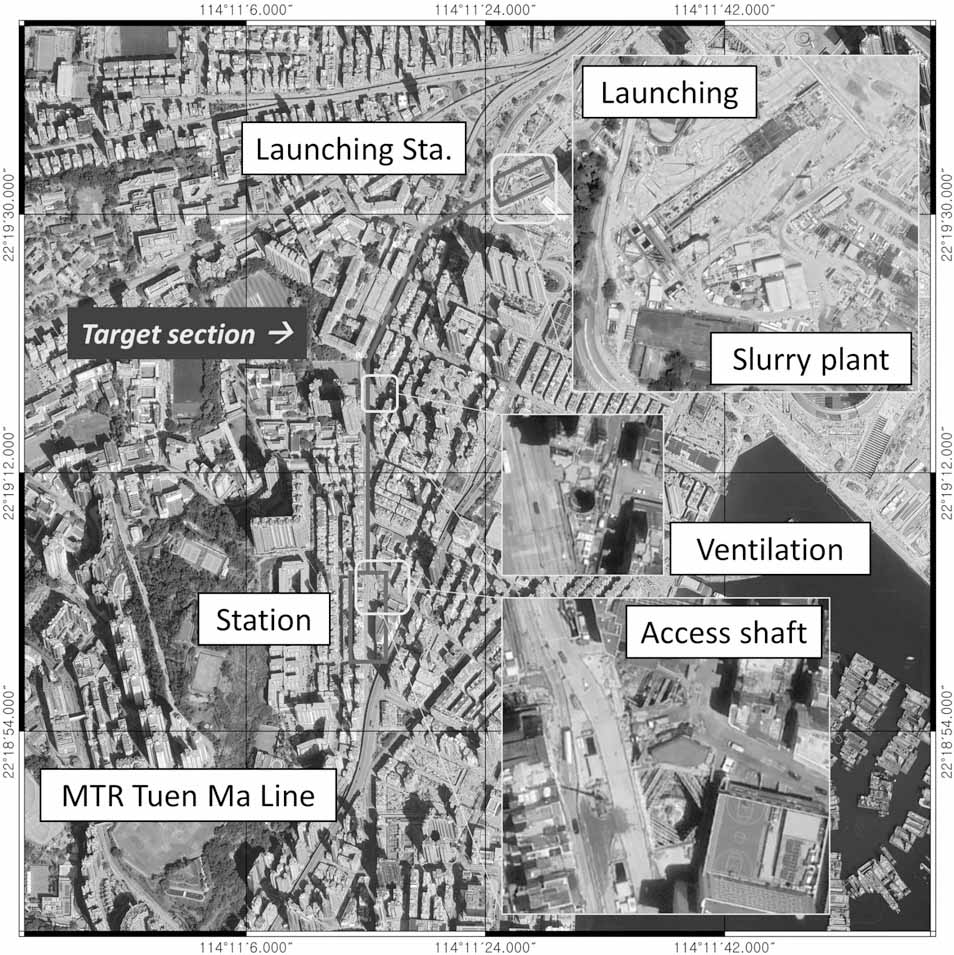
- Tunnel excavation in urban areas is often performed close to existing surface and underground structures, making construction-induced ground settlement an important monitoring target. Conventional ground-based instrumentation provides accurate point measurements but is limited in spatial coverage and long-term applicability in dense urban environments. This study evaluates the applicability of time-series interferometric synthetic aperture radar (InSAR) as a complementary monitoring approach for urban railway tunnelling. A conventional PS-InSAR analysis was first used to select stable reference ground control points; PS-InSAR with adaptive filtering was then compared with field settlement measurements, and SBAS-InSAR was applied to examine area-wide deformation patterns in non-instrumented sections. The InSAR results reproduced the overall magnitude and temporal tendency of measured settlement at five representative locations, while the SBAS-InSAR results revealed spatially asymmetric settlement troughs and migration of the maximum settlement location along the tunnel alignment. The results indicate that time-series InSAR can complement spatially limited field instrumentation by providing additional information on the spatiotemporal distribution of surface deformation. The limitations associated with single-orbit LOS-to-vertical conversion and the lack of direct field validation for SBAS-InSAR should, however, be considered when interpreting the quantitative results.
- COLLAPSE
도심지 터널 굴착은 기존 지상 및 지중 구조물과 인접하여 수행되므로 시공에 따른 지표침하를 면밀히 관리할 필요가 있다. 기존의 지상 계측 시스템은 정밀한 점 단위 계측이 가능하지만 구조물이 밀집된 도심지에서는 공간적 관측 범위와 장기 관측 측면에서 한계가 있다. 본 연구에서는 도심지 도시철도 터널 시공에 따른 지표침하 모니터링을 보완하기 위한 시계열 합성 개구 레이더 간섭기법(InSAR)의 적용성을 평가하였다. 먼저 기존 PS-InSAR 분석을 이용하여 안정적인 기준 GCP를 선정하고, 적응형 필터를 적용한 PS-InSAR 결과를 현장 계측 침하량과 비교하였다. 또한 분산 산란체(DS)를 활용한 SBAS-InSAR를 이용하여 계측기가 설치되지 않은 구간의 공간적 지표변형을 분석하였다. 적응형 필터를 적용한 PS-InSAR 결과는 5개 대표 지점에서 현장 계측 침하량과 전반적으로 유사한 변위 크기와 시간적 변화 경향을 보였으며, SBAS-InSAR에서는 터널 노선을 따라 비대칭적인 침하곡선과 최대침하 위치의 이동이 관찰되었다. 이러한 결과는 시계열 InSAR가 기존의 공간적으로 제한된 현장 계측을 대체하기보다는 지표변형의 시공간적 분포를 추가로 파악하는 보조 수단으로 활용될 수 있음을 보여준다. 다만 단일 상승궤도 자료를 이용한 연직변위 환산과 SBAS-InSAR 결과에 대한 직접적인 현장 검증이 제한적이라는 점을 고려하여 정량적 결과를 해석할 필요가 있다.
-
Evaluation of time-series InSAR applicability for ground settlement monitoring in urban railway tunnelling
-
Research Paper
-
Development of a continuous hazardous vehicle tracking method through the association of linearly deployed multiple CCTVs in tunnels
터널 내 선형 배치 다중 CCTV 연계를 통한 위험차량 연속 추적 기법 개발
-
Kyu Beom Lee, Hyun Seong Bae, Hyu Soung Shin
이규범, 배현성, 신휴성
- Potential fire-risk vehicles identified at a tunnel entrance must be continuously monitored as they travel through the tunnel, which requires maintaining consistent …
터널 진입부에서 잠재적 화재 위험차량을 선별한 이후에도 해당 차량의 위치를 지속적으로 확인하기 위해서는 터널 내부 CCTV 간에 동일 차량의 식별정보가 연속적으로 유지되어야 …
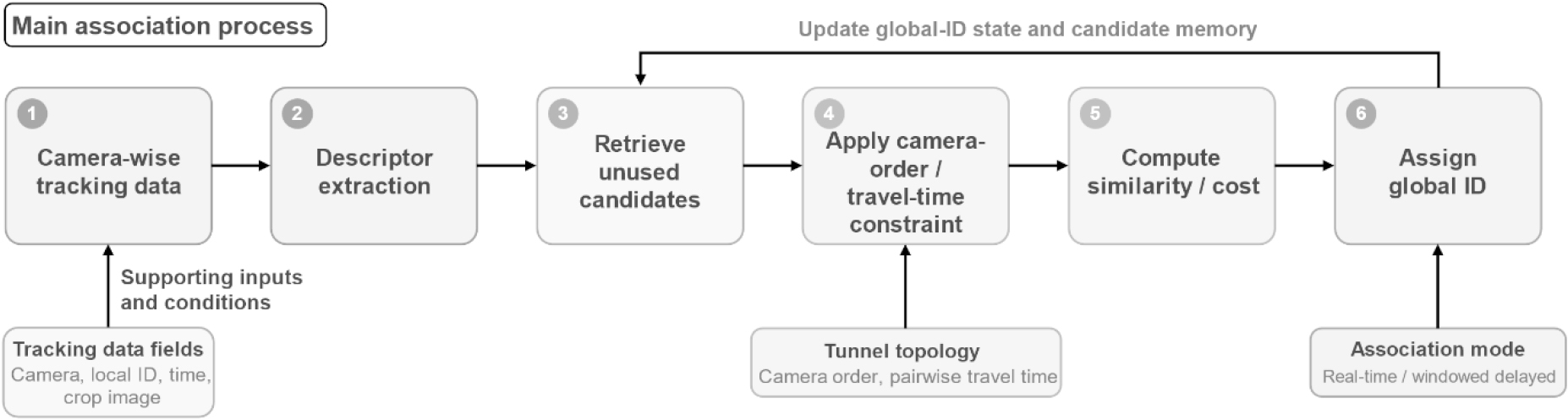
- Potential fire-risk vehicles identified at a tunnel entrance must be continuously monitored as they travel through the tunnel, which requires maintaining consistent vehicle identities across internal CCTV cameras. However, tunnel CCTV cameras are typically deployed linearly along the direction of traffic and often have non-overlapping fields of view. Consequently, the same vehicle is assigned different local IDs by individual cameras, with observation gaps occurring between cameras. To address this problem, this study developed and evaluated a global ID association method for continuous tracking of hazardous vehicles by considering the characteristics of tunnel CCTV environments. The proposed method combines camera order, travel time between adjacent cameras, and vehicle appearance features to identify the same vehicle among unused candidates from the preceding camera and inherit its global ID. Two association schemes were implemented: real-time matching, which immediately determines an association when a vehicle is observed, and windowed delayed matching, which accumulates multiple candidate relationships over a limited time window and resolves them through one-to-one assignment. The proposed method was evaluated using a synchronized 20-min sequence from six non-overlapping CCTV cameras containing 126 vehicles. The effects of HSV- and FastReID-based vehicle features and travel-time constraints were compared systematically. Real-time matching using FastReID with the travel-time constraint achieved a whole-route ID retention of 73.02% and an adjacent-camera association accuracy of 90.63%. Windowed delayed matching achieved the highest whole-route ID retention of 79.37% at a maximum confirmation delay of 1.5 s and the highest adjacent-camera association accuracy of 93.97% at 3.0 s. These results demonstrate that incorporating the linear camera arrangement and vehicle travel characteristics of tunnels into global ID association, together with candidate adjustment within a limited delay, can effectively improve the continuity of hazardous-vehicle tracking in non-overlapping multi-CCTV environments.
- COLLAPSE
터널 진입부에서 잠재적 화재 위험차량을 선별한 이후에도 해당 차량의 위치를 지속적으로 확인하기 위해서는 터널 내부 CCTV 간에 동일 차량의 식별정보가 연속적으로 유지되어야 한다. 그러나 터널 내 CCTV는 차량 진행방향을 따라 선형으로 배치되고 카메라 간 영상이 중첩되지 않는 경우가 많아, 동일 차량이라도 카메라가 변경될 때마다 서로 다른 로컬 ID가 부여되고 관측 공백이 발생한다. 이에 본 연구에서는 이러한 터널 환경의 특성을 고려하여 위험차량을 연속적으로 추적할 수 있는 전역 ID 연결 기법을 개발하고 그 성능을 검증하였다. 개발한 기법은 카메라 순서, 인접 카메라 간 통과 시간 및 차량 외형 특징을 결합하고, 이전 카메라의 미사용 후보 중 동일 차량을 탐색하여 전역 ID를 승계하도록 구성하였다. 또한 차량이 입력되는 즉시 연결을 확정하는 실시간 매칭과 일정 시간 동안 여러 후보 관계를 누적한 후 일대일로 조정하는 시간창 기반 지연 매칭을 함께 구현하였다. 개발 기법의 성능은 비중첩 CCTV 6대의 20분 동기화 영상과 차량 126대를 이용하여 검증하였으며, HSV와 FastReID 기반 차량 특징 및 통과 시간 제한의 영향을 단계적으로 비교하였다. FastReID와 통과 시간 제한을 적용한 실시간 매칭은 전 구간 ID 유지율 73.02%, 인접 카메라 연결 정확도 90.63%를 나타냈다. 시간창 기반 지연 매칭에서는 최대 확정 지연시간 1.5초에서 전 구간 ID 유지율 79.37%, 3.0초에서 인접 카메라 연결 정확도 93.97%로 가장 높게 나타났다. 이상의 결과를 통해 터널의 선형 카메라 배치와 차량 이동 특성을 전역 ID 연결 과정에 반영하고 제한된 지연 범위에서 후보 관계를 조정하는 것이 비중첩 다중 CCTV 환경에서 위험차량의 추적 연속성을 향상시키는 데 효과적임을 확인하였다.
-
Development of a continuous hazardous vehicle tracking method through the association of linearly deployed multiple CCTVs in tunnels
-
Research Paper
-
Effect of enlargement angle on ground behavior and plastic zone development in bottom-enlarged vertical shafts
하부 확폭형 수직구의 확폭각도가 지반거동 및 소성영역 발달에 미치는 영향
-
Yonggyu Lee, Mintae Kim, Changrim Choi, Chankee Kim
이용규, 김민태, 최창림, 김찬기
- In urban deep underground space development, bottom-enlarged vertical shafts, which minimize the surface footprint while securing sufficient working space at depth, are …
도심지 대심도 지하공간 개발이 확대됨에 따라 상부 점유면적을 최소화하면서 하부에서 충분한 작업공간을 확보할 수 있는 하부 확폭형 수직구에 대한 수요가 증가하고 있다. …
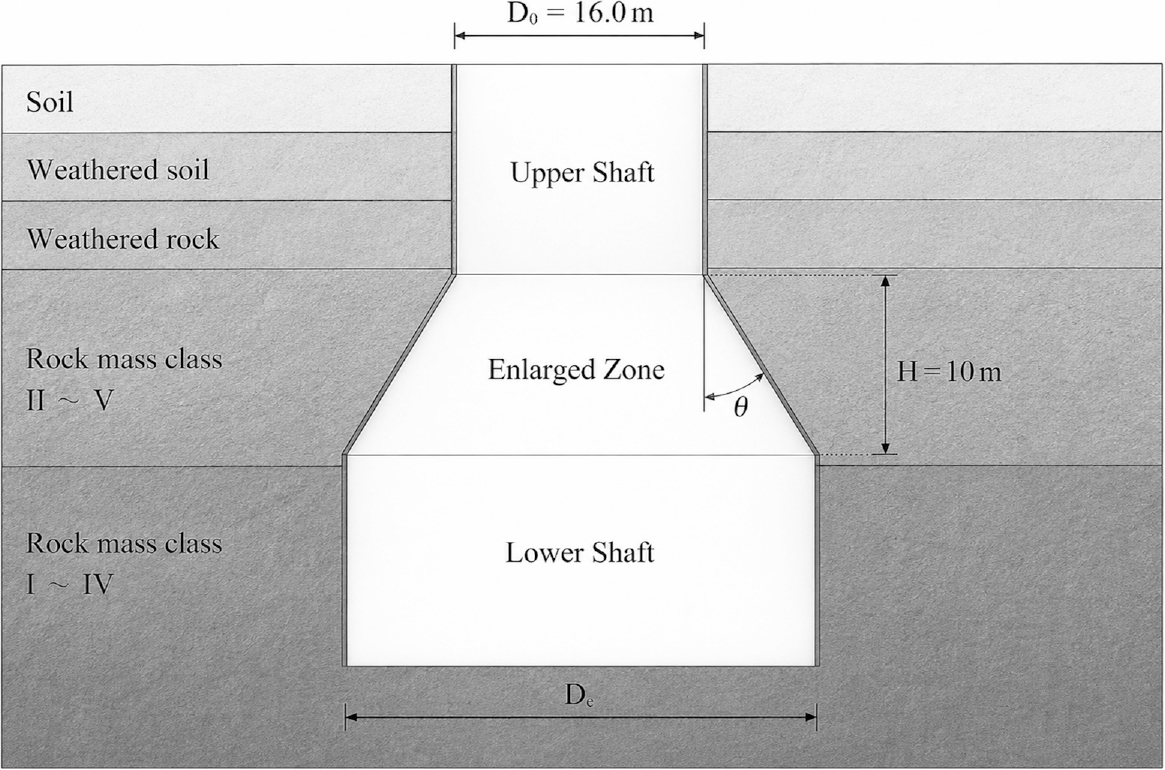
- In urban deep underground space development, bottom-enlarged vertical shafts, which minimize the surface footprint while securing sufficient working space at depth, are increasingly required for TBM launch/reception shafts and ventilation and disaster-prevention facilities. Because the abrupt cross-sectional transition between the upper straight section and the lower enlarged zone induces complex three-dimensional stress redistribution and local load concentration, a systematic understanding of the resulting behavior mechanism is still lacking. In this study, three-dimensional finite element analyses were performed with a general-purpose program to evaluate the effect of the enlargement angle on the displacement, stress and plastic-zone development of a bottom-enlarged shaft. With the upper diameter fixed at 16 m and the height of the enlarged zone fixed at 10 m, the enlargement angle was varied from 15° to 35° for rock mass grades ranging from Grade II to Grade V, giving a total of 20 analysis cases. Five monitoring points were defined along the shaft profile to trace the local response near the enlargement start and termination sections. The results show that the total and vertical displacements, and the horizontal stress, all increase with the enlargement angle, and that this sensitivity becomes markedly more pronounced as the rock mass quality deteriorates. For Grade II and III rock masses, the stress concentration generated by the abrupt geometric transition was effectively controlled within a stable arching state, indicating relatively stable behavior up to 35°, which is the maximum enlargement angle examined in this study. In contrast, for rock masses of Grade IV or lower, the loosening zone caused by lateral stress release expanded rapidly with increasing angle, and the increases in displacement and plastic zone became pronounced once the angle exceeded 25°. Within the analysis conditions and the scope examined in this study, these findings can be used as a reference for selecting an appropriate enlargement angle according to rock mass condition in the design of bottom-enlarged shafts.
- COLLAPSE
도심지 대심도 지하공간 개발이 확대됨에 따라 상부 점유면적을 최소화하면서 하부에서 충분한 작업공간을 확보할 수 있는 하부 확폭형 수직구에 대한 수요가 증가하고 있다. 그러나 상부 직벽부와 하부 확폭부가 접속되는 과정에서 발생하는 급격한 단면 전이는 복잡한 3차원 응력 재분배와 국부적 하중 집중을 유발함에도 불구하고 이에 대한 체계적인 연구는 부족한 실정이다. 본 연구에서는 범용 유한요소 프로그램을 이용하여 하부 확폭형 수직구의 확폭각도가 변위, 응력 및 소성영역 발달에 미치는 영향을 3차원 수치해석을 통해 규명하였다. 상부 직경 16 m, 확폭부 높이 10 m를 기준으로 확폭각도를 15–35°까지 변화시키고 확폭부의 암반등급을 Ⅱ등급에서 Ⅴ등급까지 조합하여 총 20개의 해석 Case를 구성하였다. 확폭 시작부와 확폭 종료부의 국부적 거동을 추적하기 위해 수직구 선형을 따라 5개의 관측점을 설정하였다. 해석 결과 합변위와 연직변위, 수평응력은 모두 확폭각도가 증가할수록 커지며 이러한 민감도는 암반등급이 불량할수록 뚜렷하게 확대되었다. 본 연구의 해석조건 및 검토범위 내에서 Ⅱ등급 및 Ⅲ등급 암반은 최대 35°까지 비교적 안정적인 거동을 보인 반면 Ⅳ등급 및 Ⅴ등급 암반은 25°를 초과할 경우 변위 및 소성영역의 증가가 현저하게 나타났다. 이러한 결과는 하부 확폭형 수직구 설계 시 암반 조건에 따른 적정 확폭각도 선정에 활용할 수 있다.
-
Effect of enlargement angle on ground behavior and plastic zone development in bottom-enlarged vertical shafts
-
Research Paper
-
Experimental investigation of spray density characteristics with spray direction control in a road tunnel water spray system
터널 내 물분무소화설비의 분사 방향 제어에 따른 살수밀도 특성에 관한 실험적 연구
-
Donghyeok Go, Jinouk Park, Seungmin Choi, Donghun Seok, Yongho Yoo
고동혁, 박진욱, 최승민, 석동훈, 유용호
- An uneven spray density in road tunnel water spray systems can create vulnerable areas where the required spray density is not achieved. …
도로터널 물분무소화설비의 살수밀도가 불균일하게 형성되면 요구 살수밀도에 미달하는 취약개소가 발생할 수 있다. 본 연구에서는 실물 규모의 2차로 도로터널 실험장에서 물분무노즐의 분사 방향 …
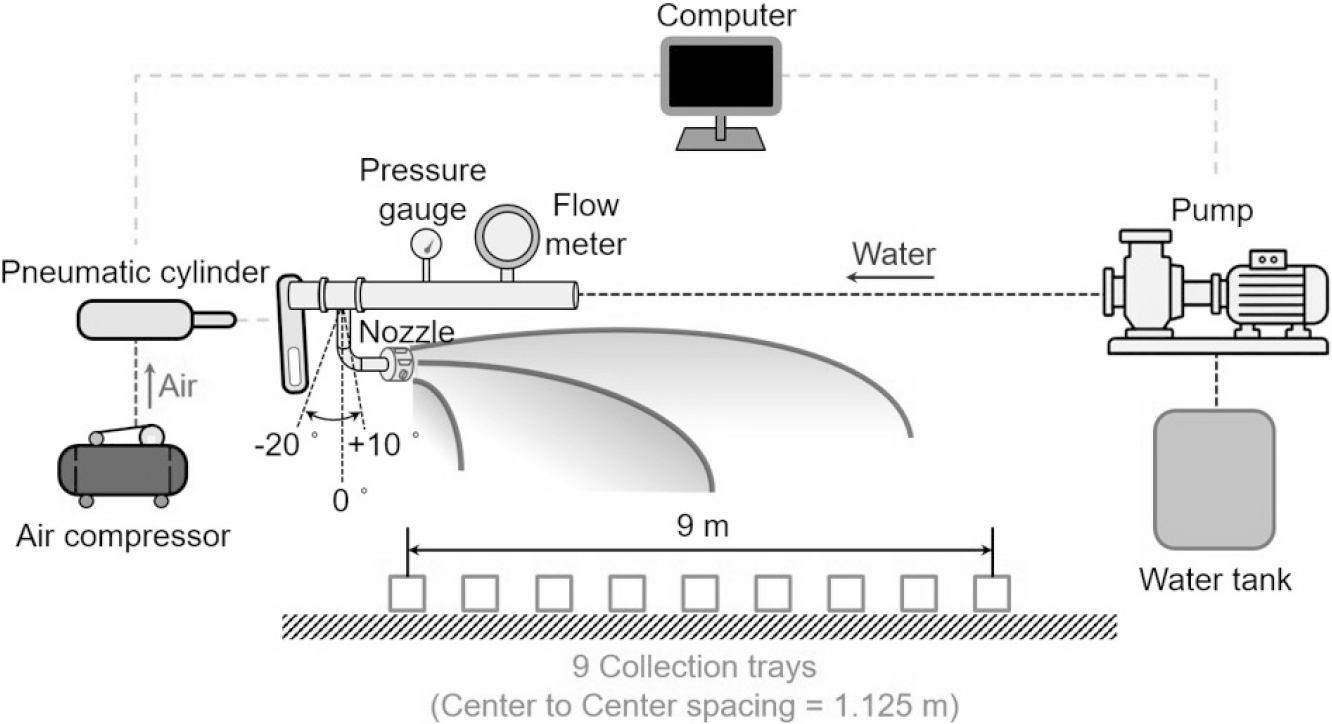
- An uneven spray density in road tunnel water spray systems can create vulnerable areas where the required spray density is not achieved. This study experimentally investigated the effects of spray direction control and operating pressure on spray density distribution in a full-scale two-lane road tunnel test facility. A total of 11 test conditions were established, and spray density was measured over a 9 m-wide section including the road shoulders. Distribution uniformity was evaluated using the standard deviation of the measured spray density. Under fixed spray conditions, shifting the spray direction toward the far-field region reduced the standard deviation from 6.32 to 2.05 L/min·m2; however, vulnerable areas below the required spray density remained in either the near- or far-field region. Under swing spray conditions, widening the swing range reduced the standard deviation from 3.44 to 1.79 L/min·m2, and the widest swing range satisfied the required spray density of 6 L/min·m2 at all measurement points. In contrast, increasing the operating pressure from 2.2 to 5 bar under fixed spray conditions enabled the required spray density to be achieved throughout the test section, but increased the standard deviation from 2.53 to 4.03 L/min·m2. These results indicate that swing spray with spray direction control is more effective than increasing the operating pressure and flow rate in simultaneously achieving the required spray density and distribution uniformity with a lower flow rate.
- COLLAPSE
도로터널 물분무소화설비의 살수밀도가 불균일하게 형성되면 요구 살수밀도에 미달하는 취약개소가 발생할 수 있다. 본 연구에서는 실물 규모의 2차로 도로터널 실험장에서 물분무노즐의 분사 방향 제어와 방수압력에 따른 살수밀도 분포 특성을 실험적으로 분석하였다. 총 11개의 실험조건을 설정하고, 길어깨를 포함한 9 m의 측정구간에서 위치별 살수밀도를 측정하였으며, 표준편차를 이용하여 분포의 균일성을 평가하였다. 고정 분사 조건에서는 분사 방향이 원거리 측으로 이동할수록 살수밀도의 표준편차가 6.32 L/min·m2에서 2.05 L/min·m2로 감소하였으나, 근거리 또는 원거리에서 요구 살수밀도에 미달하는 취약개소가 발생하였다. 스윙 분사 조건에서는 스윙 범위가 확대됨에 따라 표준편차가 3.44 L/min·m2에서 1.79 L/min·m2로 감소하였으며, 가장 넓은 스윙 범위를 적용한 조건에서는 모든 측정 지점에서 요구 살수밀도인 6 L/min·m2를 충족하였다. 반면, 고정 분사 조건에서 방수압력을 2.2 bar에서 5 bar로 증가시키면 전 측정구간의 요구 살수밀도를 충족하였으나, 표준편차는 2.53 L/min·m2에서 4.03 L/min·m2로 증가하였다. 연구 결과, 분사 방향 제어기술을 적용한 스윙 분사는 방수압력과 유량을 증가시키는 방식보다 적은 유량으로 측정구간 전반의 요구 살수밀도와 분포 균일성을 동시에 확보하는 데 효과적인 것으로 나타났다.
-
Experimental investigation of spray density characteristics with spray direction control in a road tunnel water spray system
-
Research Paper
-
Thermal image-based detection of underbody surface temperature for electric vehicles
열화상 영상 기반 전기자동차 하부 표면온도 검출방법
-
Seungmin Choi, Jinouk Park, Yongho Yoo, Donghyeok Go, Donghun Seok
최승민, 박진욱, 유용호, 고동혁, 석동훈
- This study proposes a non-contact method for detecting the underbody surface temperature of moving electric vehicles using RGB and thermal imaging cameras. …
본 연구에서는 주행 중 전기자동차의 하부 표면온도를 비접촉 방식으로 검출하기 위하여 일반카메라와 열화상카메라를 연계한 검출방법을 제안하였다. 번호판 색상정보를 이용하여 전기차량 후보를 선별하고, …
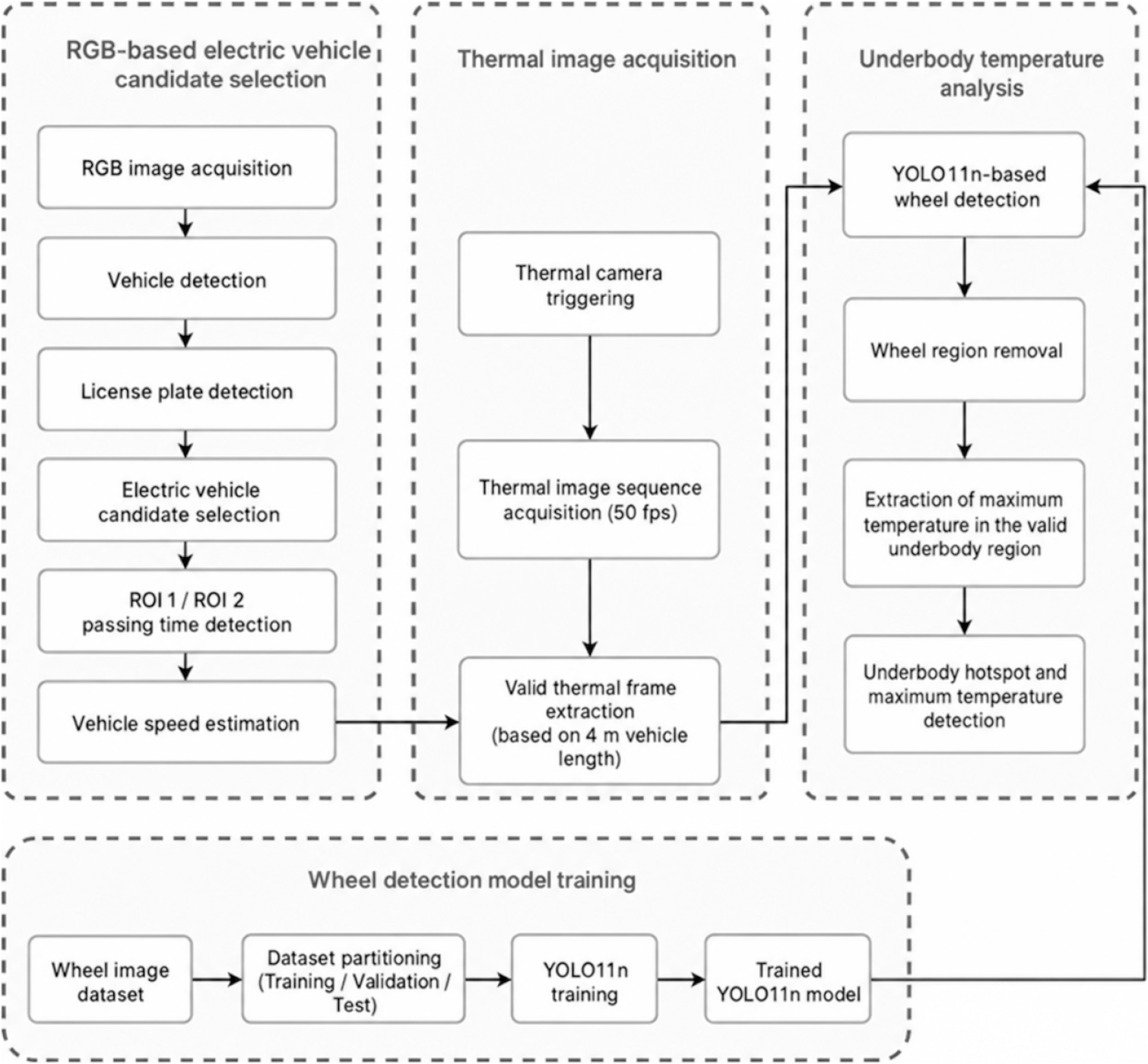
- This study proposes a non-contact method for detecting the underbody surface temperature of moving electric vehicles using RGB and thermal imaging cameras. Electric vehicle candidates were selected based on license plate color information, and vehicle speed was estimated using two regions of interest (ROIs) to extract valid thermal frames. A YOLO11n model was then used to exclude wheel regions and determine the maximum underbody surface temperature. The vehicle, license plate, and wheel detection models achieved Precisions of 0.990, 0.951, and 0.955, respectively. In simulated hazardous-vehicle tests at 80 and 100 km/h, the absolute relative error between thermal imaging and thermocouple measurements ranged from 1.5 to 8.9%, with a mean of 5.9%. These results demonstrate the applicability of the proposed method for non-contact detection of underbody high-temperature regions in moving vehicles.
- COLLAPSE
본 연구에서는 주행 중 전기자동차의 하부 표면온도를 비접촉 방식으로 검출하기 위하여 일반카메라와 열화상카메라를 연계한 검출방법을 제안하였다. 번호판 색상정보를 이용하여 전기차량 후보를 선별하고, 두 개의 관심영역(ROI)을 이용하여 차량속도를 산정한 후 유효 열화상 영상 프레임을 추출하였다. 이후 YOLO11n 모델로 바퀴영역을 제외하고 차량 하부의 최고 표면온도를 산정하였다. 차량, 번호판 및 바퀴 검출모델의 정밀도는 각각 0.990, 0.951 및 0.955로 나타났다. 또한 80 및 100 km/h 주행조건의 위험차량 모사실험에서 열화상카메라와 열전대 측정값의 절대 상대오차는 1.5–8.9%, 평균은 5.9%로 나타났다. 이를 통해 제안한 방법이 주행차량 하부의 고온영역을 비접촉 방식으로 검출하는 데 적용 가능함을 확인하였다.
-
Thermal image-based detection of underbody surface temperature for electric vehicles
-
Research Paper
-
Numerical analysis of upward cavity enlargement induced by time-dependent ground degradation and internal erosion-induced soil loss
시간 의존적 지반열화와 토사유실에 따른 지하공동 상향 확대의 수치적 분석
-
Hoki Ban, Heesu Kim, Sangyun Kim
반호기, 김희수, 김상윤
- Subsurface cavities grow as soil loss changes the cavity boundary and degradation of the surrounding ground reduces its load-carrying capacity. This study …
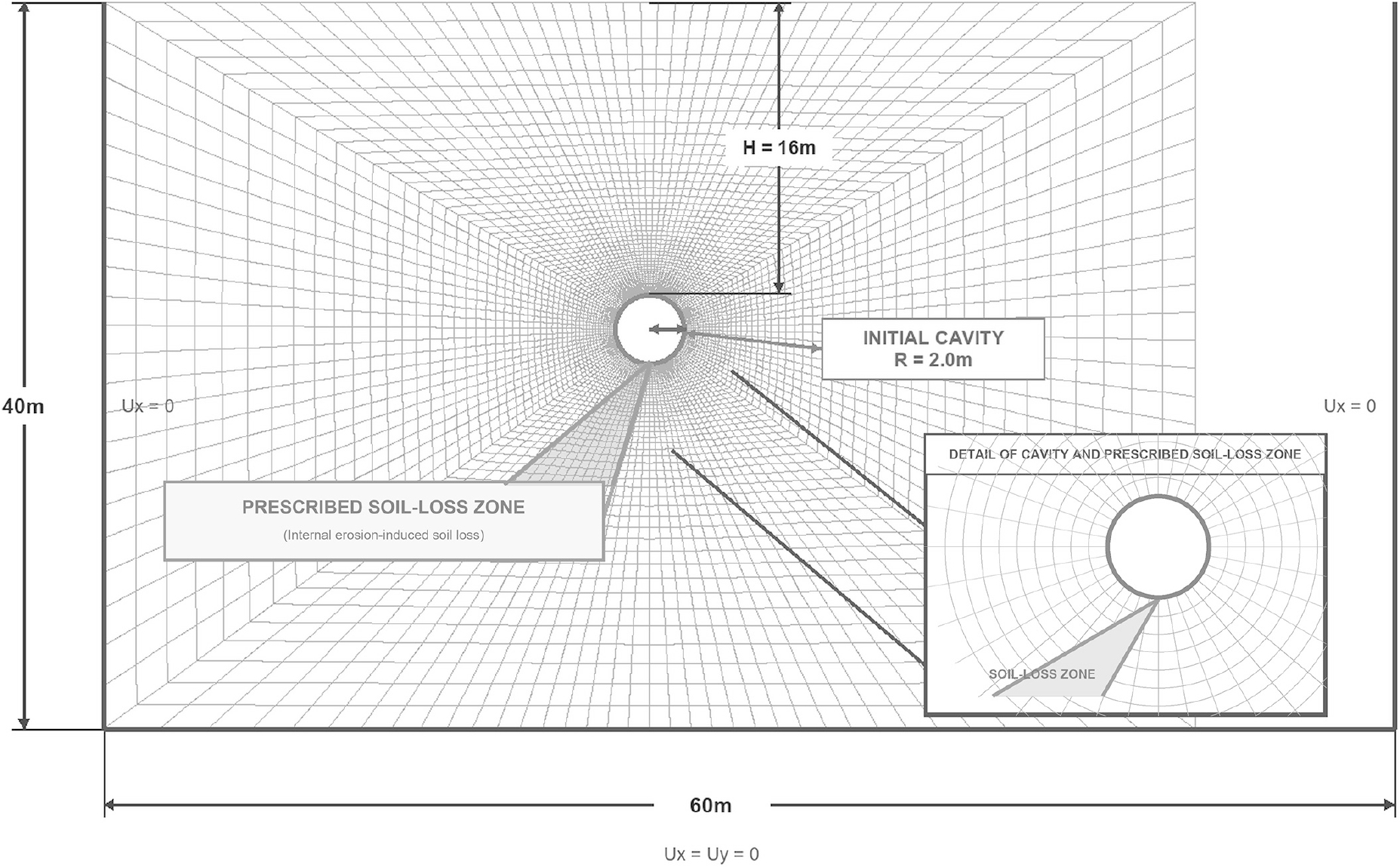
지하공동은 토립자 유실로 공동 경계가 확대되고 주변 지반의 하중전달능력이 저하되면서 발달한다. 본 연구에서는 토사유실에 따른 공동 확대가 응력 재분배, 소성변형의 국부화 및 …
- Subsurface cavities grow as soil loss changes the cavity boundary and degradation of the surrounding ground reduces its load-carrying capacity. This study investigates how soil loss, stress redistribution, plastic deformation, and roof failure combine to produce upward cavity growth and surface settlement. A two-dimensional plane-strain model distinguished imposed soil loss beneath an existing cavity from the subsequent mechanical failure of the surrounding ground. A reference condition and twelve screening cases were examined by varying ground degradation, shear strength, cover thickness, and initial cavity radius. The results revealed a common sequence: enlargement of the soil-loss boundary, redistribution of overburden load by arching, localization of plastic deformation around the roof and sidewalls, and either gradual settlement or upward propagation of a connected failure zone. Nine of the thirteen conditions reached a displacement-based limit state, whereas two maintained small settlements for ten years. Early instability was associated mainly with a large cavity and low shear strength. Time-dependent degradation controlled the timing of instability by progressively reducing cavity stability rather than causing failure independently. Cavity risk should therefore be assessed from settlement development, plastic-zone connectivity, and the extent of cavity enlargement together.
- COLLAPSE
지하공동은 토립자 유실로 공동 경계가 확대되고 주변 지반의 하중전달능력이 저하되면서 발달한다. 본 연구에서는 토사유실에 따른 공동 확대가 응력 재분배, 소성변형의 국부화 및 천단부 파괴를 거쳐 지표침하로 이어지는 과정을 분석하였다. 기존 공동 하부에 사전 지정한 토사유실과 이후 주변 지반의 파괴를 구분한 2차원 평면변형 해석을 수행하였으며, 기준 조건과 12개 영향인자 선별 조건을 이용하여 지반열화, 전단강도, 토피고 및 초기 공동반경의 영향을 비교하였다. 해석 결과, 공동은 토사유실 영역의 확대, 아칭효과에 의한 상재하중의 재분배, 천단과 측벽에서의 소성변형 국부화, 파괴영역의 상향 연결 순으로 발달하였다. 총 13개 조건 중 9개에서는 최대 증분변위가 설정한 기준값을 초과한 뒤에도 계속 증가하였으나, 2개 조건에서는 10년 동안 작은 침하만 발생하였다. 초기 공동반경이 크고 전단강도가 낮을수록 불안정 전이가 빨랐다. 시간 의존적 지반열화는 단독으로 붕괴를 유발하기보다 지반의 안정성을 점진적으로 낮추어 불안정 전이 시점을 앞당겼다. 따라서 공동 위험도는 지표침하의 발달, 소성영역의 연결성 및 파괴에 의한 공동 확대를 함께 고려하여 평가할 필요가 있다.
-
Numerical analysis of upward cavity enlargement induced by time-dependent ground degradation and internal erosion-induced soil loss
-
Research Paper
-
Analysis of ground deformation and structural stress during shield TBM Pull-back and subsequent connection construction for a power cable tunnel
전력구 터널 쉴드TBM Pull-back 및 후속 접속 시공에 따른 지반변형과 구조물 응력 분석
-
Sanggyu Song, Yunhee Kim, Bumjoo Kim
송상규, 김윤희, 김범주
- In the construction of urban underground power-line (utility) tunnels, installing an arrival shaft is often difficult due to limited working space and …
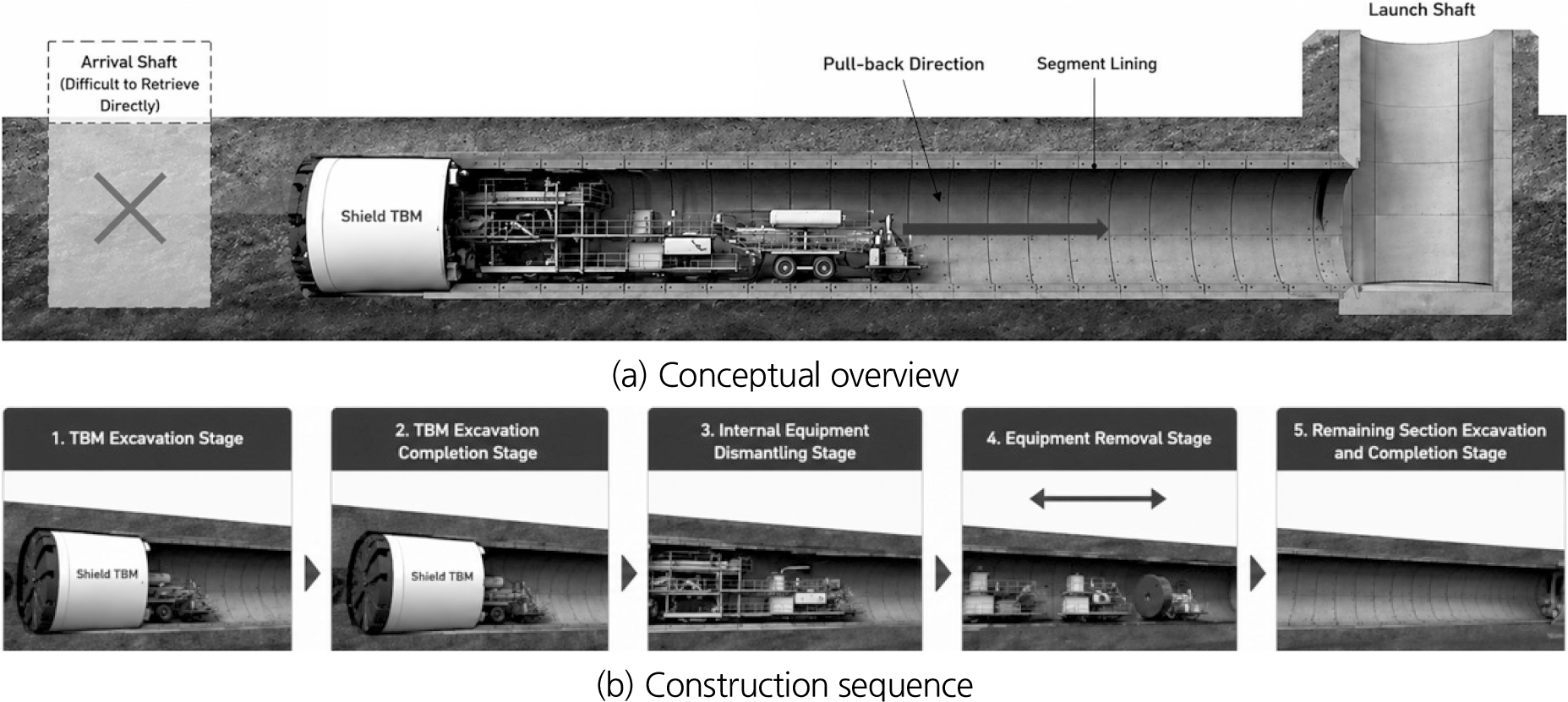
도심지 전력구 터널 시공에서는 제한된 작업 공간과 기존 지하 구조물의 영향으로 도달수직구 설치가 어려운 경우가 발생한다. 이러한 조건에서는 TBM (Tunnel Boring Machine)을 …
- In the construction of urban underground power-line (utility) tunnels, installing an arrival shaft is often difficult due to limited working space and the influence of existing underground structures. Under such conditions, the Pull-back method—in which, after tunnel excavation is completed using a TBM (Tunnel Boring Machine), the equipment is dismantled inside the tunnel and then retrieved and removed toward the launch shaft—can be considered as an applicable construction approach. However, after applying the Pull-back method, connection with the existing structure requires not only face pressure release and internal equipment dismantling/removal but also continuous excavation of the remaining section and subsequent connection works, all of which necessitate an evaluation of ground deformation and structural stability throughout the entire construction process. In this study, three-dimensional finite difference analyses using FLAC3D were performed to evaluate the behavior characteristics of the ground and structures according to ground and reinforcement conditions during the shield TBM Pull-back and subsequent connection construction process for a power-line tunnel. The numerical analysis simulated, in a stepwise manner, TBM excavation, face pressure release, internal equipment dismantling, manual excavation of the remaining section, and connection with the existing shaft, and compared and analyzed ground settlement and structural stress under various reinforcement methods for soft rock, weathered rock, and weathered soil ground conditions. The analysis results showed that the combined reinforcement condition applying grouting, shotcrete, and rock bolts together exhibited the greatest effect in reducing settlement; in particular, the crown settlement of approximately 88 mm under the unreinforced weathered soil condition decreased to 3.9 mm under the combined reinforcement condition, confirming a settlement reduction of about 96%. Meanwhile, the stresses generated in the existing vertical shaft, TBM skin plate, and segment structures remained within the allowable stress range under all analysis conditions, indicating that structural stability was secured. The results of this study are expected to serve as useful basic data for understanding the behavior of the ground and structures according to ground and reinforcement conditions during the shield TBM Pull-back and subsequent connection construction process, and for establishing appropriate reinforcement measures when necessary.
- COLLAPSE
도심지 전력구 터널 시공에서는 제한된 작업 공간과 기존 지하 구조물의 영향으로 도달수직구 설치가 어려운 경우가 발생한다. 이러한 조건에서는 TBM (Tunnel Boring Machine)을 이용해 굴착 시 터널 굴착 완료 후 장비를 내부에서 해체한 후 발진수직구 방향으로 회수 및 반출하는 Pull-back 공법 적용을 고려할 수 있다. 다만, Pull-back 적용 이후 기설구조물과의 접속을 위해서는 막장압 해제와 내부 장비 해체·반출뿐만 아니라 잔여 구간 굴착 및 접속 시공이 연속적으로 수행되므로 전체 시공과정에서 발생하는 지반변형과 구조물의 안정성 검토가 요구된다. 본 연구에서는 FLAC3D를 이용한 3차원 유한차분해석을 통하여 전력구 터널에 대해서 쉴드TBM Pull-back 및 후속 접속 시공과정에서 지반 및 보강조건에 따른 지반과 구조물의 거동 특성을 평가하였다. 수치해석에서는 쉴드TBM 굴착, 막장압 해제, 내부 장비 해체, 잔여 구간 수동굴착 및 기설수직구 접속 과정을 단계별로 모사하였으며, 연암, 풍화암 및 풍화토 지반조건을 대상으로 다양한 보강공법 적용 시 지반 침하와 구조물 응력을 비교·분석하였다. 해석 결과, 그라우팅과 숏크리트 및 록볼트를 함께 적용한 복합보강 조건에서 침하량 저감 효과가 가장 큰 것으로 나타났고, 특히 풍화토 지반 무보강 조건에서 약 88 mm의 천단침하가 3.9 mm로 감소하여 약 96%의 침하 저감이 발생함을 확인하였다. 한편, 본 연구에서 설정한 해석조건과 허용응력 기준에서는 기설수직구, 쉴드TBM 스킨플레이트 및 세그먼트 라이닝에 발생한 응력이 모두 허용범위 이내로 나타났다. 또한, 보강공법 중에서는 그라우팅, 숏크리트 및 록볼트를 병행한 복합보강이 가장 우수한 침하 저감 효과를 나타내었다. 본 연구 결과는 쉴드TBM Pull-back 및 후속 접속 시공과정에서 지반과 보강조건에 따른 지반·구조물의 거동을 이해하고 필요시 적정 보강방안을 수립하는 데 기초자료로서 유용할 수 있을 것으로 기대한다.
-
Analysis of ground deformation and structural stress during shield TBM Pull-back and subsequent connection construction for a power cable tunnel
-
Research Paper
-
Single-sensor-based circumferential position estimation during waterjet pipe cutting using machine learning
기계학습을 이용한 단일 센서 기반 워터젯 관 절삭 위치추정
-
Si-Yun Kwon, Tae-Hyun Kong, Jun-Sik Park, Jae-Sung Park, Tae-Min Oh
권시윤, 공태현, 박준식, 박재성, 오태민
- Aging utility infrastructure in utility tunnels has increased the need for maintenance and replacement. Remotely operated pipe cutting in confined spaces requires …
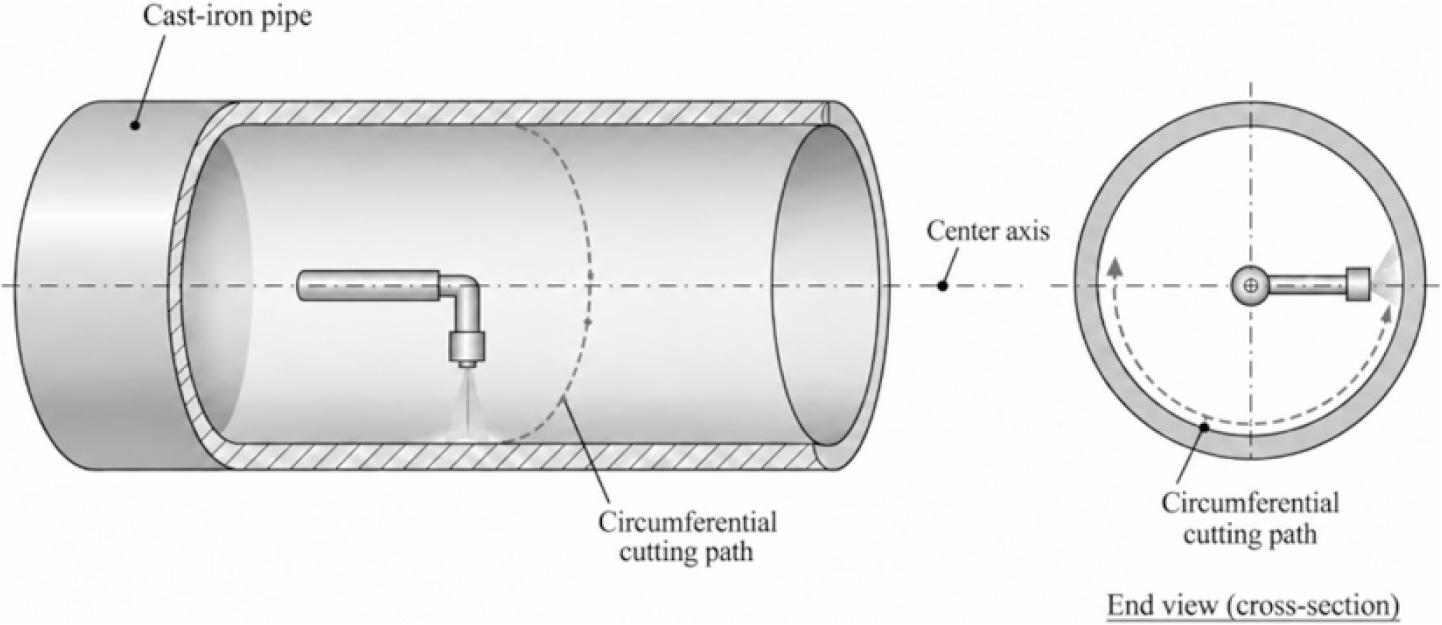
공동구 내 수용시설의 노후화가 진행됨에 따라 상수관의 유지관리 및 교체 필요성이 증가하고 있다. 특히 제한된 작업공간에서 원격으로 수행되는 관 절삭작업은 절삭 진행상태와 …
- Aging utility infrastructure in utility tunnels has increased the need for maintenance and replacement. Remotely operated pipe cutting in confined spaces requires a sensing method for monitoring cutting progress and estimating the circumferential position of the cutting point. In this study, a single-sensor-based method using elastic-wave signals generated during waterjet pipe cutting was evaluated. Tests were performed on a cast-iron pipe with an outer diameter of 532 mm, and signals were measured at axial distances of 50, 100, 150, and 200 mm from the cutting line. Fifteen time-domain features and five regression models were used for position estimation. Random forest showed stable performance across the sensor conditions and was selected as the representative model. The highest performance was obtained at a sensor distance of 100 mm, with a Circular MAE of 101.14 mm and an R2 of 0.9069. The Circular MAE according to circumferential position ranged from 35.00 to 251.82 mm, with relatively large errors in the initial, 30–40%, and final cutting regions. These results indicate that the circumferential position of the waterjet cutting point can be estimated using elastic-wave signals measured by a single sensor.
- COLLAPSE
공동구 내 수용시설의 노후화가 진행됨에 따라 상수관의 유지관리 및 교체 필요성이 증가하고 있다. 특히 제한된 작업공간에서 원격으로 수행되는 관 절삭작업은 절삭 진행상태와 원주방향 절삭위치를 파악하기 위한 계측기술이 요구된다. 본 연구에서는 워터젯 관 절삭 과정에서 발생하는 탄성파 신호를 이용하여 단일 센서 기반 절삭위치 추정기법을 평가하였다. 외경 532 mm의 주철관을 대상으로 절삭선으로부터 50, 100, 150 및 200 mm 이격된 위치에서 탄성파 신호를 계측하였다. 계측신호에서 15개의 시간영역 특징변수를 추출하고 5개 회귀모델을 적용하였다. Random forest는 전체 센서 조건에서 안정적인 성능을 나타내어 대표 회귀모델로 선정되었으며, 100 mm 이격조건에서 Circular MAE 101.14 mm, R2 0.9069로 가장 높은 성능을 나타냈다. 원주방향 위치별 Circular MAE는 35.00–251.82 mm로 나타났으며, 절삭 초기부, 30–40% 구간 및 종료부에서 상대적으로 높은 오차가 발생하였다. 본 연구결과는 단일 센서에서 계측한 탄성파 신호를 이용하여 워터젯 절삭 과정의 원주방향 절삭위치 추정 적용 가능성을 나타낸다.
-
Single-sensor-based circumferential position estimation during waterjet pipe cutting using machine learning
-
Research Paper
-
CEL large-deformation analysis of leakage-induced subsurface cavity development with saturation-dependent soil-property reduction and seepage erosion
관 누수에 따른 포화도 의존 지반 물성 저하와 침투·침식을 고려한 지중공동 발달의 CEL 대변형 해석
-
Hoki Ban, Jaemo Kang
반호기, 강재모
- An Eulerian large-deformation model was developed within a CEL analysis framework to examine the initiation and enlargement of subsurface cavities induced by …
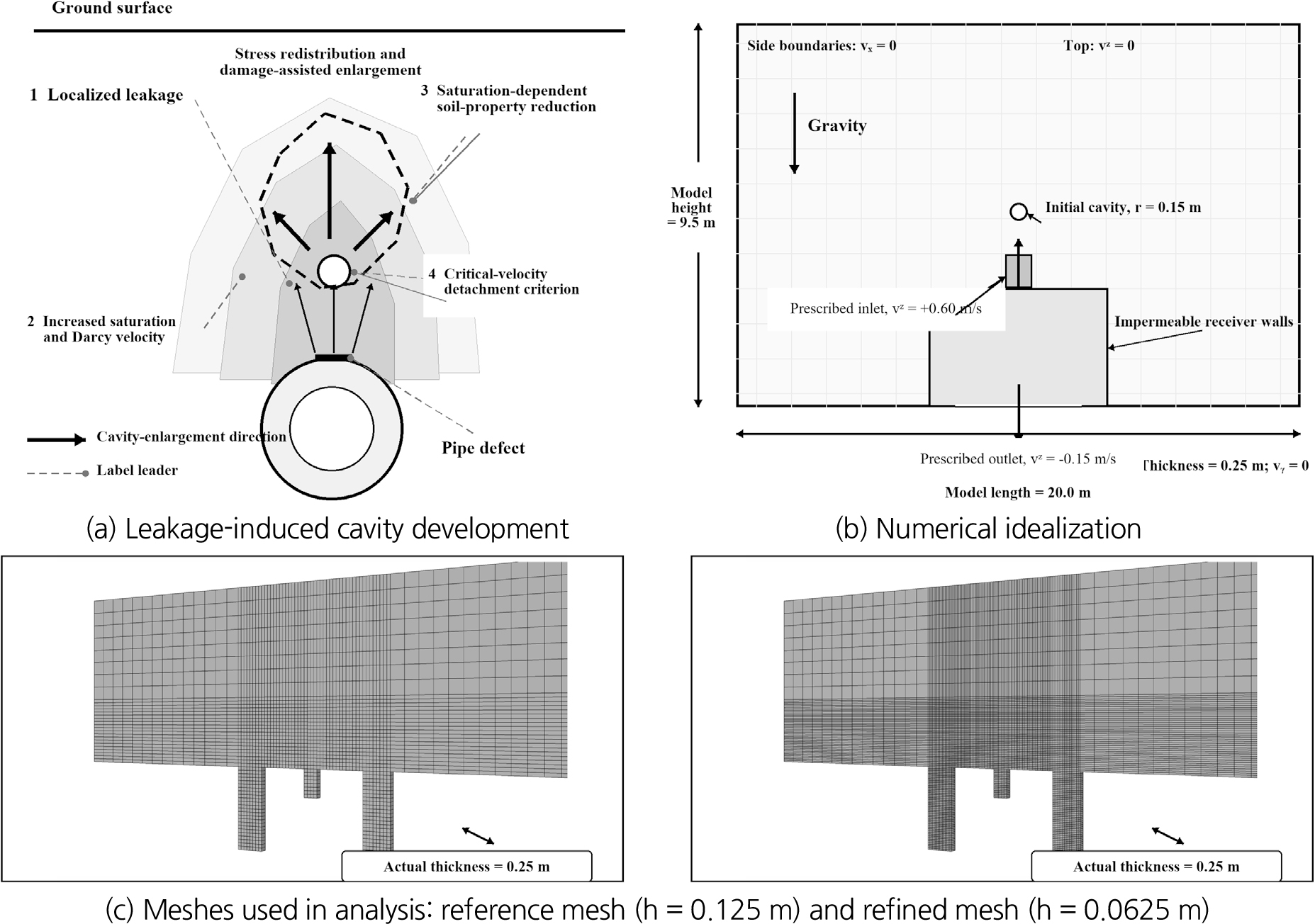
본 연구에서는 관 누수로 인한 지중공동의 개시와 확대를 분석하기 위해 CEL 기반 Eulerian 대변형 모델을 구성하였다. 별도의 30-day 유한체적 침투해석에서 산정한 유효포화도와 …
- An Eulerian large-deformation model was developed within a CEL analysis framework to examine the initiation and enlargement of subsurface cavities induced by pipe leakage. Effective saturation and Darcy velocity obtained from a separate 30-day finite-volume seepage analysis were transferred sequentially to the mechanical model. Elastic stiffness, shear and tensile strengths, and fracture energy were reduced irreversibly as functions of the maximum historical effective saturation. Seepage erosion was activated when the critical Darcy velocity was reached within material connected to a seed cavity with a radius of 0.15 m; subsequent enlargement was classified according to the first activated tensile-damage or shear-localization criterion. In the reference analysis, the first element reached a detachment criterion under the hydraulic state corresponding to 1 day of leakage. With the 30-day hydraulic state held constant, the final failed-region area and the maximum upward extent from the seed-cavity crown were 1.875 m2 and 0.638 m, respectively. No element reached a detachment criterion in the matched comparison analysis without transferred hydraulic fields. Increasing the critical Darcy velocity delayed initiation and reduced the failed region. Mesh refinement preserved the initiation time and predominant growth directions, while the quantitative measures changed by approximately 10–15%. Because particle transport, recalculation of hydraulic fields following cavity enlargement, and surface collapse were excluded, the model is suited to interpreting the cavity-development process and comparing hydraulic scenarios rather than predicting field-scale cavity size or occurrence time.
- COLLAPSE
본 연구에서는 관 누수로 인한 지중공동의 개시와 확대를 분석하기 위해 CEL 기반 Eulerian 대변형 모델을 구성하였다. 별도의 30-day 유한체적 침투해석에서 산정한 유효포화도와 Darcy 유속의 시간별 분포를 역학모델에 순차적으로 전달하고, 최대 이력 유효포화도에 따라 지반의 탄성강성, 전단·인장강도 및 파괴에너지를 비가역적으로 감소시켰다. 침투·침식 기준은 반경 0.15 m의 초기 공동과 연결된 영역에서 Darcy 유속이 설정 임계값에 도달할 때 적용하였으며, 이후 공동 확대에 관여한 요소는 처음 도달한 인장응력 손상 또는 전단변형 집중 기준에 따라 구분하였다. 기준해석에서는 누수 1일의 수리상태에서 첫 요소가 이탈기준에 도달하였다. 30-day 수리상태를 고정한 최종 역학응답에서 파괴영역 면적과 초기 공동 천단 기준 최대 상향 확장거리는 각각 1.875 m2와 0.638 m였다. 수리상태를 적용하지 않은 비교해석에서는 이탈기준에 도달한 요소가 없었다. 임계유속을 높일수록 이탈 개시는 지연되고 파괴영역은 감소하였다. 메쉬를 세분화해도 개시시점과 주된 확장방향은 유지되었으나 정량지표는 약 10–15% 변하였다. 본 모델은 입자 이송, 공동 확대에 따른 지하수 흐름의 재산정 및 지표함몰을 포함하지 않으므로, 현장 공동의 크기와 발생시간을 예측하기보다 공동 확대 과정을 해석하고 수리조건별 상대응답을 비교하는 데 적합하다.
-
CEL large-deformation analysis of leakage-induced subsurface cavity development with saturation-dependent soil-property reduction and seepage erosion

Journal Informaiton
 Journal of Korean Tunnelling and Underground Space Association
Journal of Korean Tunnelling and Underground Space Association








 Korean Tunneling and Underground Space Association
한국터널지하공간학회
#1411, 304, Hyoryeong-ro, Seocho-gu, Seoul, 06720, Korea
Tel: +82-2-3465-3663 / Fax: +82-2-3465-3666 / E-mail: ktastaff@hanmail.net Copyright© Korean Tunneling and Underground Space Association. Powered by APUB
Tel: +82-2-3465-3663 / Fax: +82-2-3465-3666 / E-mail: ktastaff@hanmail.net Copyright© Korean Tunneling and Underground Space Association. Powered by APUB